Best International Schools in Luxembourg: 2026 Guide for Families
Quick answer: What are the best international schools in Luxembourg? Luxembourg runs two tracks. Fee-paying: the International School of Luxembourg (IB, EUR 20,480 to 24,226 a year) and St George's International School (British, EUR 14,750 to 19,695). State-funded: the European Schools, Athénée de Luxembourg's IB classes and Lycée Michel Lucius's English-medium Cambridge stream.
Last reviewed: October 2026 by David from ISA. Fee ranges are indicative; always confirm with the school.
Few countries give international families as many tuition-free options as Luxembourg. Alongside private schools charging more than EUR 20,000 a year, the state runs English-medium and European-curriculum schools that charge no tuition, and the European Schools educate the children of EU staff without fees. That changes the question families should ask. Choosing among the best international schools in Luxembourg is not only about quality; it is about which track your child is eligible for, which language section fits, and whether a fee-paying place adds enough to justify the cost.
This guide is organised around those two tracks. It covers five schools in or near Luxembourg City, using each school's 2026-27 fee schedule and admissions rules, and official information from the Luxembourg government and the European Schools system.
Luxembourg City for families: Kirchberg, Merl and beyond
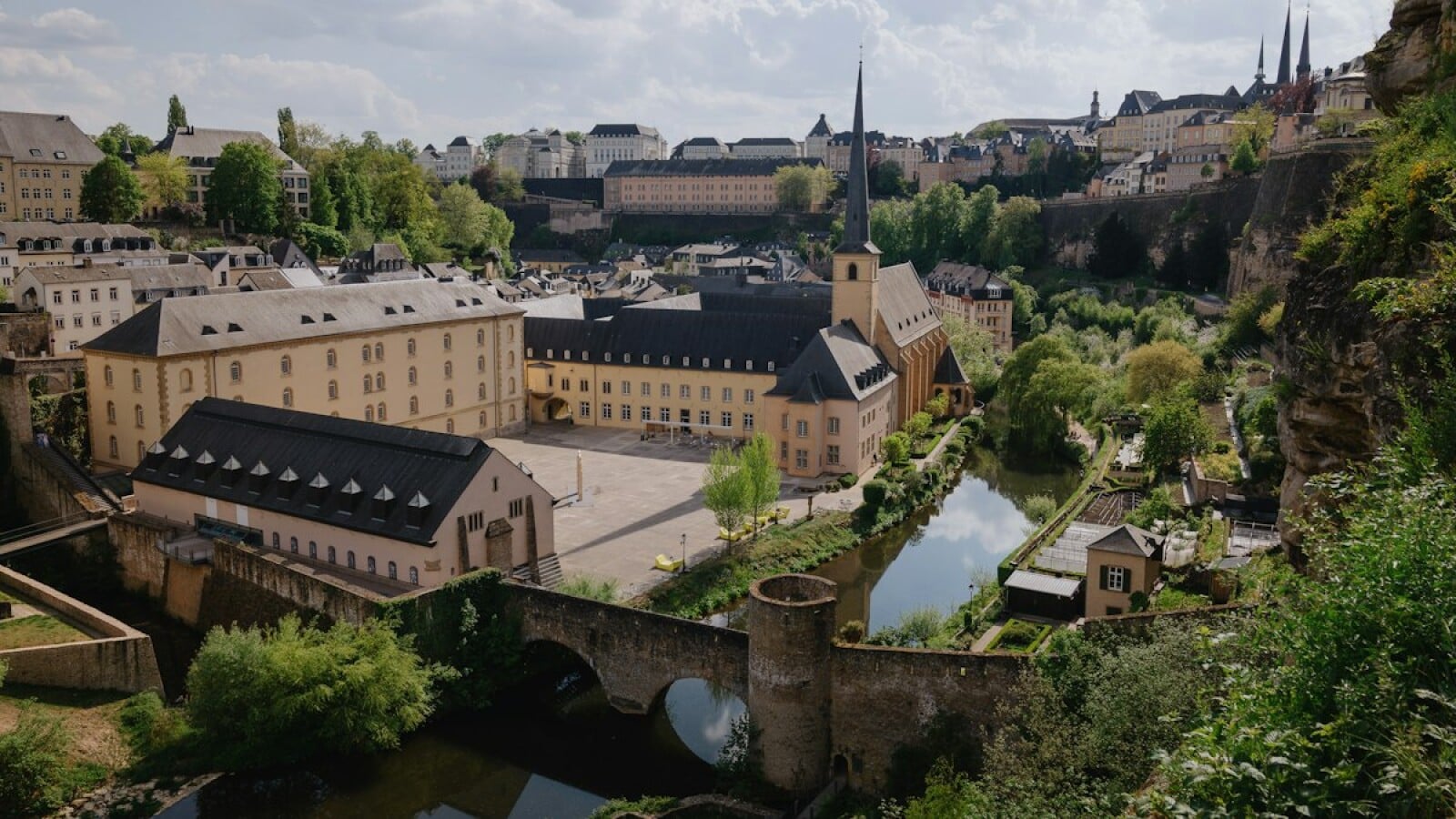
Most international families arrive for jobs in the EU institutions on Kirchberg, in banking and fund management, in Big Four firms or in tech and logistics. The city is compact, but schools are spread across distinct districts. Kirchberg, the plateau to the north-east, hosts the European institutions and the European School Luxembourg I. Merl and Belair, west of the centre, are where the International School of Luxembourg and the Athénée sit, on the same boulevard. St George's is in Hamm, to the east, and the European School Luxembourg II is in Bertrange, just outside the city to the south-west.
Many families also live in Strassen, Bertrange, Mamer or Hesperange, and some cross the border daily from France, Belgium or Germany. Public transport in Luxembourg is free, which makes trams and buses a realistic school-run option for older children, but morning road traffic from the border regions can be heavy. If your employer is on Kirchberg and your child's school is in Hamm, check the journey before you sign a lease.
Curricula available in Luxembourg
- International Baccalaureate: the International School of Luxembourg is authorised for the Primary Years Programme and the Diploma Programme and is an MYP candidate school; the Athénée de Luxembourg offers the IB Diploma in its English-medium international classes.
- British curriculum: St George's International School teaches a British programme leading to GCSEs, A Levels and BTEC qualifications.
- Cambridge International: Lycée Michel Lucius's international stream teaches Cambridge Lower Secondary, IGCSEs and AS and A Levels.
- European Baccalaureate: taught at the two European Schools of Luxembourg and at the state's accredited public European schools, in English, French and German language sections.
- Luxembourgish system: trilingual state schooling in Luxembourgish, German and French, which many long-term residents choose.
Five schools across the two tracks
International School of Luxembourg (ISL)
ISL began in 1962 around a dining room table in Strassen and now has more than 1,300 students and over 250 staff on its campus in Merl, at 36 Boulevard Pierre Dupong. It is accredited by the Council of International Schools and the Middle States Association, following a joint visit in September 2023, and it lists the IB as authorising its PYP and DP, with the MYP at candidate stage. In the final years, students can also follow the Global Impact Diploma pathway.
Who it suits: families who want the IB from early years and a large, established international community. Tip: ISL's fees already benefit from a state subsidy for private schools that averages roughly EUR 12,755 per child, according to its 2026-27 schedule. Residential trips are mandatory from Grade 2 to Grade 10 and charged separately, from EUR 190 to 290 in Grade 2 up to EUR 1,200 to 1,300 for the Grade 10 trip to Switzerland.
St George's International School
St George's, at 11 rue des Peupliers in Hamm, is a non-profit British school from Nursery to Year 13 that says it has grown steadily over the past 35 years, with GCSEs in Years 10 and 11 and A Levels or BTEC qualifications in the Sixth Form. The school estimates that the Ministry of Education's operating subsidy will cover 30% of its 2026 operating budget, and it sets fees after taking the subsidy into account. In secondary, fees include most class supplies and textbooks on loan, residential trips (a double trip in Years 10 and 12, so none in Years 11 and 13) and, from Year 11 to Year 13, examination fees.
Who it suits: families who want a British pathway, children who may join part-way through the year (Nursery to Year 9 can join throughout the year), and those who want BTEC as well as A Levels. Tip: children do not need English to apply, and the school plans to introduce an Immersive English Programme in Primary from 2027. Read the withdrawal clause carefully: without written notice by the set dates, parents pay one third of annual tuition in lieu of notice.
European School Luxembourg
The European Schools of Luxembourg operate on two sites: Luxembourg I at 23 Boulevard Konrad Adenauer on Kirchberg and Luxembourg II at 6 rue Gaston Thorn in Bertrange. Both run German, English and French vehicular sections, with further language sections split between the sites, and both lead to the European Baccalaureate. Pupils are assigned to a site largely by where they live.
Eligibility drives everything here. Category I pupils, children of staff of the European institutions employed for at least a year, are exempt from fees. Category II pupils are admitted under agreements with employers who pay the cost of schooling. Category III pupils, everyone else, are admitted only if places remain, never into a class that already has 27 or more pupils, and pay fees set each year by the Board of Governors of the European Schools; for 2026-27 they had to pay a non-refundable 25% of the fee by 26 June 2026. Tip: the schools warn that complete files take six to eight working weeks to process from 1 May.
Athénée de Luxembourg
The Athénée, at 24 Boulevard Pierre Dupong, is a state lycée. Its international classes have been accredited by the IBO since 2010 and, since September 2017, have offered a full seven-year English-medium secondary education: three preparatory years (Grades 7 to 9), two intermediate years (Grades 10 and 11) and the IB Diploma in Grades 12 and 13. The school says almost 200 students are in the international classes, within a school of about 1,400.
Tip: admission is selective and on fixed dates. Grade 7 applicants sit English and maths tests; Grade 10 and 11 applicants also need French at CEFR level A2 or A2+. Admission days are 13 April 2027 for Grade 7 and 15 April 2027 for Grades 10 and 11, with results on 20 April 2027, and the open day is on 21 January 2027.
Lycée Michel Lucius International School
Lycée Michel Lucius is a state-funded secondary school in the city centre that opened an English-language international stream in 2011. It teaches Cambridge Lower Secondary, IGCSEs and AS and A Levels, and in 2017 it added a primary section, now in Limpertsberg. The school says it now has more than 1,500 students and over 150 teachers across all sections.
Who it suits: families who want a British-style Cambridge pathway in English without private fees. Tip: because it is part of the state system, admissions and timetables follow public school rules; ask early about places in your child's year group.
Fees in Luxembourg for 2026-27
Fee-paying international schools cost roughly EUR 14,750 to 24,226 a year in 2026-27, around USD 16,600 to 27,300 at the European Central Bank's reference rate of 16 October 2026. The state-funded options charge no tuition, although families still pay for lunches, trips and materials.
- ISL: EUR 20,480 (Foundations to Grade 1), EUR 22,118 (Grades 2 to 5), EUR 24,005 (Grades 6 to 8) and EUR 24,226 (Grades 9 to 12), including a EUR 350 School Growth Fund and a Stability Reserve.
- St George's: EUR 14,750 (Nursery and Reception), EUR 16,100 (Years 1 and 2), EUR 17,330 (Years 3 to 6), EUR 18,400 (Years 7 to 9) and EUR 19,695 (Years 10 to 13), including a EUR 1,500 Building Fund and EUR 200 Stability Fund.
- European Schools: free for Category I; paid by the employer for Category II; Category III fees are set annually by the Board of Governors.
- Athénée and Lycée Michel Lucius: state schools, so no tuition; Eurydice notes that public education in Luxembourg is free and funded by the State budget.
Extras to budget for:
- Application fees: EUR 300 at ISL and EUR 750 at St George's, both non-refundable.
- Registration and deposits: a EUR 3,000 registration fee at ISL, due within two weeks of an offer; a EUR 1,000 deposit at St George's, added to the first bill to cover extras and refunded in the last extras bill after the student leaves.
- Trips and snacks: mandatory residential trips at ISL (roughly EUR 190 to 1,300 depending on grade) and EUR 340 a year for healthy snacks in Grades 1 to 5.
- Devices: ISL Upper School students bring their own laptop, and from Grade 7 need a graphing calculator (EUR 151).
- Lunch: paid separately through the school caterer at ISL and billed as extras at St George's.
Families often overlook the public European schools. Luxembourg's public European schools are accredited by the European Schools system under an accreditation agreement and follow the European Schools' curricula, but are run as part of the national school network and funded by the national budget, so enrolment is free, according to the EU's Eurydice network. The Ministry of Education signed the accreditation of the École internationale Mersch Anne Beffort in July 2022 and renewed that of the École internationale de Differdange et Esch, the first, opened in 2016; the École internationale Gaston Thorn opened in Luxembourg City in September 2022. These schools offer English, French and German sections and lead to the European Baccalaureate.
Practical advice for Luxembourg families
Check your category before anything else. If one parent works for an EU institution, a Category I place at a European School is free and well established. If not, compare a Category III place with the public European schools and the fee-paying options; the public schools may offer the same Baccalaureate without the cost.
Plan around fixed dates in the state system. Selective public programmes such as the Athénée's international classes test applicants on fixed days in April, while private schools such as St George's admit pupils throughout the year where space allows. A family arriving in November may find the private route is the only immediate option.
Read the leaving rules as well as the joining fees. Corporate contracts in Luxembourg can be short. St George's charges a third of annual tuition if notice is missed. At ISL, fees become contractually binding once you sign the enrolment agreement, and after 30 June a share of the year's tuition is owed depending on when you give notice. Ask HR whether your package covers notice penalties as well as tuition.
See the full ranking
For a wider view, including schools outside the capital, see our ranking of the best international schools in Luxembourg.
More guides to schools in Luxembourg
- International school admissions in Luxembourg
- How to choose an international school in Luxembourg
- International school fees in Luxembourg
- Bilingual schools in Luxembourg
- best international schools in Luxembourg
Frequently asked questions
Are there free international schools in Luxembourg?
Yes. The state's accredited public European schools, such as the École internationale Gaston Thorn in Luxembourg City, teach the European curriculum in English, French and German sections and are funded by the national budget, so enrolment is free. State lycées such as the Athénée and Lycée Michel Lucius also run English-medium IB and Cambridge programmes.
Can non-EU staff children attend the European School Luxembourg?
Yes, as Category III pupils, but only where places remain after Category I and II applicants are placed, and never in a class that already has 27 or more pupils. Category III families pay fees set annually by the Board of Governors, and for 2026-27 a non-refundable 25% was due by 26 June 2026.
How much does the International School of Luxembourg cost?
For 2026-27, total annual fees at ISL range from EUR 20,480 for Foundations to Grade 1 up to EUR 24,226 for Grades 9 to 12. New families also pay a EUR 300 application fee and a EUR 3,000 registration fee, plus mandatory residential trips and, in the Lower School, a EUR 340 snack charge.